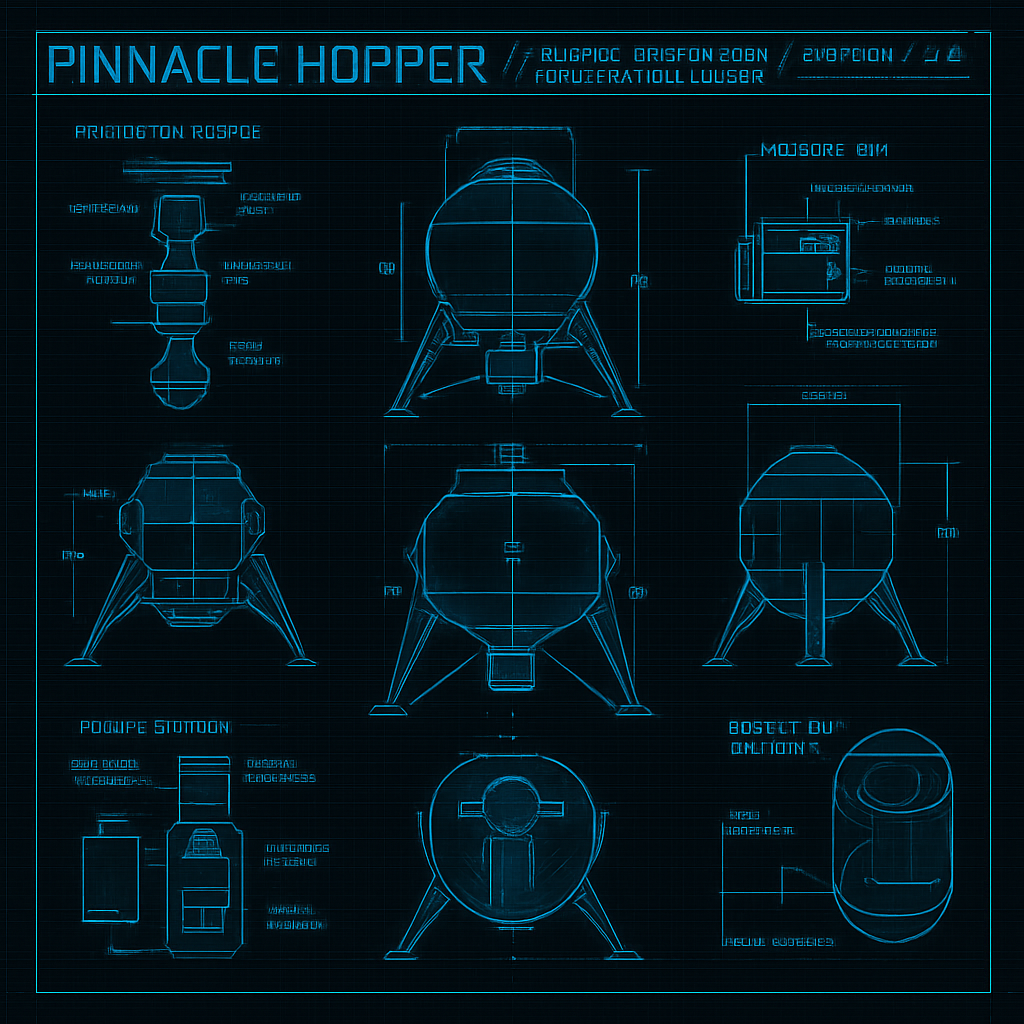
Technical schematic background
WHITE PAPER — THE DOCTRINE

THE PINNACLE HOPPER DOCTRINE

A comprehensive technical and strategic document outlining the architecture, rationale, and deployment roadmap for the next epoch of lunar mobility.

Version 2.1 | Last Updated: March 2026
01

EXECUTIVE SUMMARY

The Pinnacle Hopper Program represents a fundamental reimagining of lunar surface mobility. Rather than extending Earth-based transportation paradigms to the Moon, this program acknowledges the unique characteristics of the lunar environment and designs specifically for them.

The Moon's one-sixth gravity, absence of atmosphere, and extreme terrain present challenges that wheeled vehicles cannot efficiently address. The Hopper architecture embraces flight as the primary mode of transportation — not as a luxury or emergency measure, but as the optimal, everyday method of moving across the lunar surface.

This white paper presents the strategic rationale, technical architecture, and operational concept for a fleet of autonomous, flight-capable vehicles that will form the transportation backbone of permanent lunar civilization.

02

PROBLEM STATEMENT

Why Wheels Are Obsolete on the Moon

Traditional wheeled rovers face fundamental limitations in the lunar environment:

Terrain Constraints: The lunar surface is characterized by craters, boulders, slopes, and regolith of varying depth and consistency. Wheeled vehicles must navigate around obstacles, significantly increasing travel time and energy consumption.
Dust Contamination: Lunar regolith is electrostatically charged and mechanically abrasive. Wheeled locomotion generates substantial dust that contaminates seals, bearings, optical surfaces, and thermal radiators.
Speed Limitations: Safe wheeled travel speeds on rough terrain rarely exceed 10 km/h. For a civilization-scale infrastructure requiring regular transport over hundreds of kilometers, this creates unacceptable inefficiency.
Range Constraints: Battery mass and wheel wear limit practical wheeled range to tens of kilometers before requiring maintenance or recharging — inadequate for global lunar operations.

The Hopper architecture eliminates these constraints entirely by operating above the surface.

03

STRATEGIC RATIONALE

Why Flight Is the Next Epoch of Lunar Mobility

The lunar environment is uniquely suited to flight-based transportation:

Gravity Advantage: At one-sixth Earth gravity, the energy required for vertical lift is dramatically reduced. A vehicle that would require massive thrust on Earth becomes practical with modest propulsion on the Moon.
Vacuum Efficiency: Without atmospheric drag, all propulsive energy translates directly to motion. Hypersonic ballistic trajectories become routine.
Direct Routing: Flight enables point-to-point travel regardless of surface topology. A flight path between two points is always shorter than any surface route.
Dust Avoidance: Operating above the surface minimizes regolith interaction to brief landing and takeoff phases, protecting vehicle systems.
Scalability: Flight-based logistics scale efficiently. Adding capacity means adding vehicles, not constructing roads or rails.

The strategic implication is clear: any lunar infrastructure investment in surface roads or rail systems represents misallocation of resources. Flight is the natural mode of transportation for the Moon.

04

TECHNICAL ARCHITECTURE

Engineering for Lunar Flight

The Hopper technical architecture comprises six integrated subsystems:

Propulsion: Variable-thrust aerospike engines provide efficient operation across the full flight envelope. Deep throttling enables precision hovering and landing. ISRU-compatible propellant systems allow local refueling.
Autonomy: The Noyron neural architecture enables fully autonomous operations including navigation, hazard avoidance, mission planning, and fleet coordination without human intervention.
Structure: Computational design produces mass-optimized structures impossible to conceive through traditional engineering. Each generation improves upon its predecessors.
Power: Regenerative fuel cells provide power during flight. Solar arrays and battery systems support ground operations. Nuclear options exist for polar operations with limited solar access.
Thermal: Active thermal management maintains system temperatures across the 300°C swing between lunar day and night.
Communications: Direct and mesh networking enables vehicle-to-vehicle coordination and Earth/orbital relay links for mission control.
05

OPERATIONAL CONCEPT

How Hopper Fleets Operate

Hopper fleet operations follow a distributed, autonomous model:

Mission Assignment: Central mission control or distributed AI assigns transport tasks based on cargo requirements, vehicle availability, propellant status, and priority.
Flight Planning: Individual vehicles compute optimal trajectories considering energy efficiency, timing constraints, and coordination with other fleet movements.
Execution: Autonomous flight execution with continuous self-monitoring and adaptive replanning as conditions change.
Coordination: Swarm protocols enable fleet-wide optimization, including formation flying for large cargo, relay operations for extended range, and cooperative surveying.
Maintenance: Self-diagnosis identifies maintenance requirements. Vehicles autonomously return to maintenance facilities or request mobile service units.
Refueling: ISRU facilities produce propellant from lunar resources. Vehicles dock at distributed refueling stations positioned throughout the operational area.

Day-to-day operations require minimal human oversight. Human involvement focuses on mission definition, exception handling, and strategic planning.

06

DEPLOYMENT TIMELINE

From Development to Civilization Scale

**Phase 1: Pathfinder (2027-2028)** - First prototype vehicle - Earth-based testing and validation - Lunar simulation campaigns - Initial partner integration

**Phase 2: Pioneer Operations (2028-2030)** - First lunar deployment (2-3 vehicles) - Artemis Base support operations - Operational learning and refinement - ISRU integration testing

**Phase 3: Network Expansion (2030-2033)** - Fleet scaling to 50+ vehicles - Full South Pole coverage - Regular commercial operations - Second-generation vehicle deployment

**Phase 4: Global Operations (2033-2040)** - Hundreds of coordinated vehicles - Global lunar coverage - Manufacturing facilities on the Moon - Third-generation evolution

**Phase 5: Self-Sustaining (2040+)** - Zero Earth dependency for fleet operations - On-Moon vehicle manufacturing - Continuous generational improvement - Permanent infrastructure status

07

LONG-TERM VISION

The Hopper as Permanent Lunar Species

The ultimate vision extends beyond vehicles to infrastructure biology.

The Hopper fleet will evolve continuously. Each generation incorporates improvements derived from operational experience, technological advancement, and computational optimization. Over decades, the fleet will become increasingly capable, efficient, and autonomous.

Eventually, the distinction between "fleet" and "infrastructure" dissolves. The Hoppers become a permanent feature of the lunar environment — as fundamental to lunar civilization as roads and railways are to Earth.

This is not merely a transportation system. It is the beginning of a new category of technological life — engineered species designed to thrive in extraterrestrial environments and support human expansion into the cosmos.

The Pinnacle Hopper Program is the first step toward that future.

DOCUMENT CLASSIFICATIONPUBLIC RELEASE | PINNACLE AEROSPACE SYSTEMS